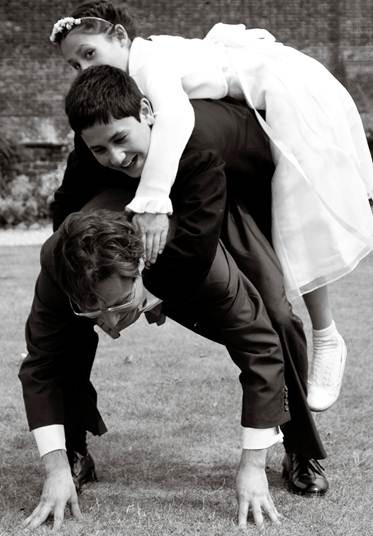
Dadhood

Toys, bike, scooter, bags, I-tunes, Wi.

not enough money or will to run a child like a department

so sit on your blackberry all morning

and decades later , expect all sorts of pain.

Back at work tomorrow, grateful partner keeps exhausted kids home and near the loo.

Or fight it off

Push sunglasses back over thinning hair

Wear too trendy shoes

Move body away as if to say: those are not mine

Cling to singledom in the face of a full nappy

Or let Dadhood dawn

know how to fail

whims cannot be met

Every game is not perfect

You can do a nappy, but thank you for the advice

Dadhood is a state of mind

A state of grace too

Be grateful

When it is ever granted to you

It lasts less than a whisper and then

Their bodies are running away fast

and they know how to poo.

You cannot text them back.

You need to let them fly.

Multiple Sclerosis

1.

The colour of the ceiling

Artex swirls which revolve if the drip has been off can sometimes be as many as six colours at once

Not only colours

Shades too: grey, white, a little rose, hint of blue, off white behind, yellow white at different times of day

The six colours vary. That is, they vary when I see that far

Carer arrives, their names change but their hands are always cold

As she lifts me, I am taken by a wave

The board beneath my feet feels firm

My arm muscles strain, I must turn

I have never seen the bed sores on my back but I imagine them as gradual, inch by inch, decay

Like the compost heap in my garden

My prize winning raised beds

I hope Barry has been weeding them right up to the lawn

The edges of my body are giving up

Each cell has fought so long

Now they surrender
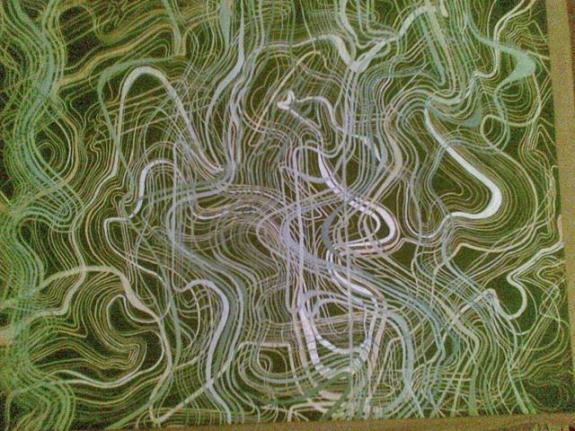
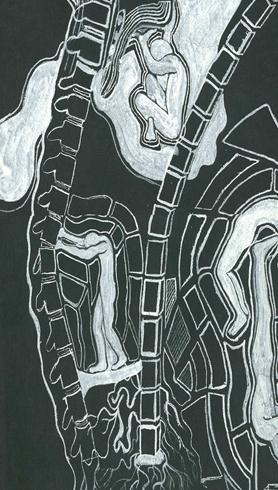
Claudia Finnis, Lines, circa 1988

2.

The board swings back towards the sun, it blinds me for a second, the sail drops

I pull back with every bit of my free arm pulling

I am upright and suddenly still

The water glistens, the Greek sea, warm, warm sun, a fresh gust, I am nineteen

My body rests again on the scabs, the sheet of the mattress, plastic cover

The mattress itself has moved little

They should turn it

The scabs are searching for a new resting place, to settle back again

The cover moves, the cushions behind are warm

These is a faint smell from outside

I feel the pollen in the air

My geraniums must be flowering by now

And the apple blossom

Will live and die without me ever seeing them

The drip is turned up, the wind lofts

Fills the sail, suddenly, very quick now, skimming the aqua green sea

Across the slow moving waves

Steer into the wind to pick up speed

My muscles feel surer

I adjust my feet, toes dig in, knees bend a little

I arc my spine forwards once more

Bend my knees a little more

My spine holds on to my board

My spine holds

The scabs achieve their place, become peaceful

Mum will be here soon and the next job will be to eat
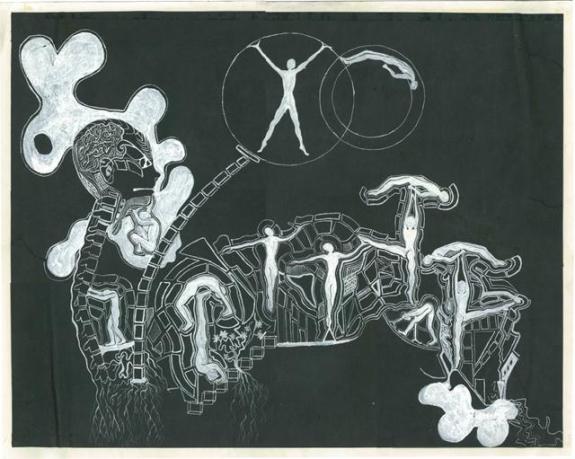
Claudia Finnis, Spine, Circa 1983

3.

I am thirty four

The colours have shifted again

Six more shades, none the same

Barry looks in

Says something I do not catch

The radio is on, Radio Four

I push a word across my mouth, keeping one side closed it emerges, and then another, slower

“Turn         it         up”

The carer leans in. I smell her sweet perfume and soap

Like the Jasmine by the shed

Has it been cut back?

What time of year is it?

What month?

Perhaps on Gardeners Question Time

“What dear?”

“Turn         it         up”

Small salvia drip onto my neck

She has not noticed

It will dry there

The stems of my roses reminded me of spines

Claudia Finnis, Spine, circa 1983, Detail

4.

I need to tack round against the swell

And head back towards the beach

The wind has changed yet again and suddenly there is the swell

I’m going over, inevitable

Board tips up and throws me off into the sea

Tied on, so I pull the board back, re-board

Dad’s on the beach with the camera

Better take the board in carefully, give Dad a good shot.

The sun is behind him

The picture will be good
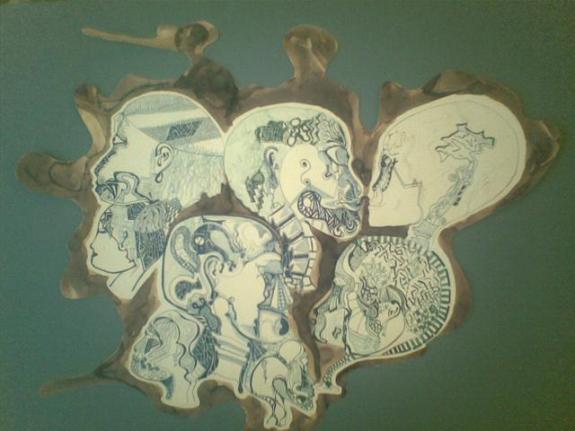
Claudia Finnis, Heads, circa 1983

5.

The Archers over, time for medication

There is an itch now at the base of my spine

Like my wet bikini with sand in

My spine that mocks me everyday

A tingle like a slight pain

Just where I cannot reach it

When I move back the scabs again will shift

The itch will be forgotten

The spit has dried

There are as many shades of pain as colours on my ceiling

Some are constant, remain through each day

Some are special visitors

I can measure days, months, years, out, in terms of the quality, texture, name and location of the pain.

A grand tour of my body’s self-destruction

Planned and carried out by my bloody spine

But I try not to. It is, as it is

There are seasons within seasons in this room

But they are all the same

Nothing seems to grow in here

There is no warm sea

Only the urine bag
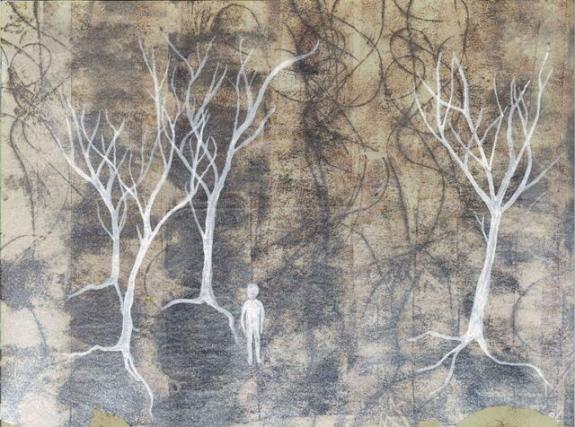
Claudia Finnis, Trees, Child, circa 1983

6.

One day the first bud came through

I was in my chair

It was just peeking through the surface of the soil to greet me!

The garden was taking shape

“Mum put that by the pond”

“Turn around the chair”

“Good”

“Can you put the compost in the greenhouse?”

“Shall we enter?”

“Yes, of course”

“Well then we need to work harder”

“What about the raised beds?”

“Let’s plan it out”

Every project to keep the spine in place

How?

Now the morphine is my only project
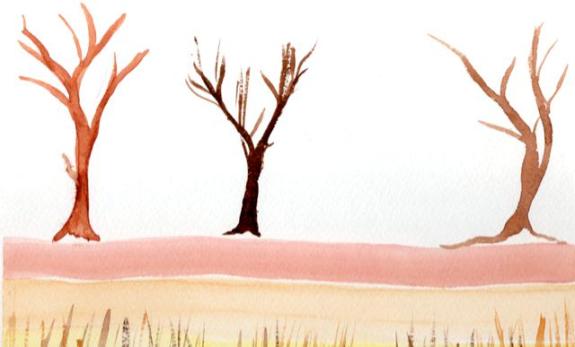
Claudia Finnis, Trees, circa 1990

7.

When was that, my last trip in the chair?

When I was….

The Archers is over

Two hours to tea time

Four hours to Mum time

Carer on her break

The hole in the day, the hour of fullest despair

Will I make it to forty?

I could call someone

Or someone could come

One of the children

My fingers seem cold

Let me remember my spine

Each segment in turn

And try to decide once and for all, which one gave me all this
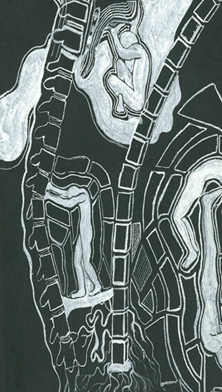
The itch is back

The shades are at six times six now

Shadows over more

My board is drying in the sun

Dad will frame the picture

My flowers one day will bloom

I will never again leave this room
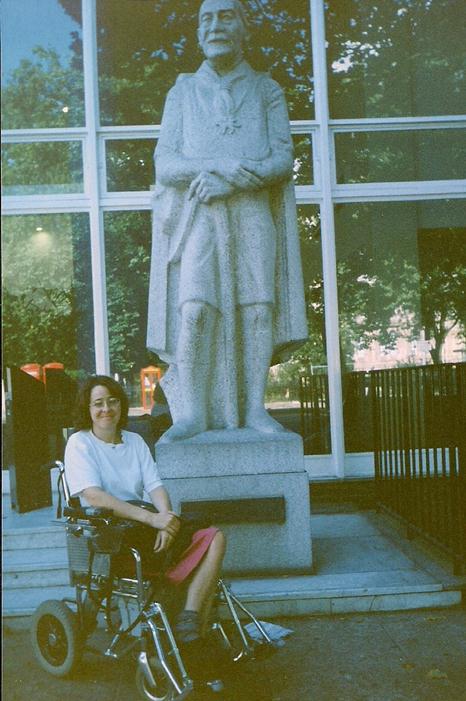
Words: Brian Brivati. Paintings: Claudia Finnis, nee Brivati (1964-2010)

Vintage


vintage

Vintage

If I could bottle him right now

This moment of quiet being

And if I could bottle her

Right now

As she pretends to be tiffy

I would later,

Long after they have stopped calling

Long after they have their own

Long after this perfect afternoon,

Take a sip of them

The nectar of their childhoods

And remember

How good it was

To be with them young

Sonhood 10

Scan_Pic0013

Scan_Pic0004

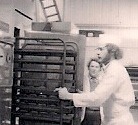
Westerns were Dad’s favourite kind of film. He would sometimes imagine himself as the grouchy rancher in one of his beloved John Wayne movies: with his trusty men, his hands. Together they would get the stage home or the herd through. The group of “ranch hands” formed a distinctly motley, though not uncharismatic, crew. Dad often called them the Merry Men. Over time the cast of characters changed but the main ones I remember were all associated with Elliot Road though many had worked for my Dad since our first large bakehouse, Kimberley Road. The Italians, Justino and Vincenzo and Luigi, were bakers and drivers. The English – Trevor and Robert the pastry, Bernard the clean, Big Rod the driver, Town Centre Sean, John the Ugly, Annie the Huge, Dave the Foreman, Dave the Hippy Baker, Ginger Gordon, Sleeping Terry, Ed the army (and we learnt later the paedophile), and others who have faded from my memory. Then there were the Swamp brothers who ran dispatch.

John (Jumbo), Ray and the youngest, Terry. Terry reminds me now of the young Robert De Niro in Mean Streets – all edge and energy. Jumbo was a crawler who flattered my Dad and the rest of us but who also worked with energy, packed and drove a delivery van and was obsessed by Poole Pirates speedway team. He used to call me Blue after Blue Boy in the cowboy series the High Chaparral. Ray the elder brother worked very hard and always looked grumpy.

The Italians, and the actual bakers -Bernard, Robert, Trevor, Dave and Gordon – were basically honest and decent workers who were paid too much overtime. Vincenzo and Justino’s worst offence was to claim to be stranded in Italy at the end of their annual holidays for no apparent reason, sometimes for weeks. Many of the rest, whose names I cannot remember, were chancers who charmed or conned my father into keeping them on or would simply turn up when no one else did. They would also, if not too hung over or late, work decently hard for the money. The clock ticking, my father shouting, the dough rising, providing the impetus.

They all played along with the notion of forming a crew. But the reality was that the only person being “got out of the shit” was my father himself. I remember an exchange in the bake house once, I do not remember whom it was between. My father was asking someone to help him with something. They agreed saying “Yes, I only do it for love”. Someone else shot back: “Yeah, love of money like the rest of us”. Dad looked crestfallen.

Sometimes we arrived in the middle of the shift when it is more difficult to get things organised because you have to work around others. However, more often I worked from the beginning of the night or on a Sunday morning when we baked especially for our most successful shop, Gigi in Christchurch. On this morning I was coming in to fry the doughnuts and then help with the packing up of the orders for dispatch.

Jumbo once made a very basic error. Someone gave him a tee shirt with “John the Baker Boy” written on it and he wore this to the bake house. He had a naturally enthusiastic nature and had not stopped to think. He was not a baker. There was a solid demarcation between those who baked and those who packed and delivered. It was a divide that could not be crossed. But Jumbo’s family who gave him the tee shirt did not understand this. The bakers, especially the bread bakers, teased him hard for his audacity. He had crossed a line and made a claim, which inside the confines of the bake house made him look ridiculous.

The otherwise mild and sensible Bernard led the charge. He seemed to be genuinely affronted by the tee shirt. There were those who made the stuff and there were the others. The makers were the artisan elite in this little world. They made, and as the word implies, they confected, and were therefore on top. Then there were the packers and the drivers.

Jumbo’s tee shirt brought home the uncomfortable reality that the backroom boys, the bakers, were not the ones the public associated with the bread. The front of house deliverymen were, to the outside world, the baker boys. Jumbo with his good humoured energy was the bringer of the morning goods. He liked the smiles that spread across faces as he arrived with the delivery but he forgot about the rules of the bake house and was made to pay. I remember him walking out of the bakery visibly upset by the taunting. We never saw the tee shirt in the bake house again, though he might have put it on once he was out on his round.

One of the perfect moments in a shift was taking a break just before dawn. Watching the beginning of a sunrise. Some of the drivers would by now have begun to load their vans. Less smoking and grumbling from the drivers was a sign that the emphasis had shifted in the focus of the night’s work from production to distribution. The packers now became the centre of activity. These packers worked in different ways. Some laid all their orders out in their designated part of dispatch. They began adding to each order every item that was ready when it was ready. Other packers who worked on the smaller later rounds could afford to work their way down the list in order and leave only a few items to add at the last moment. Those who worked in the daytime came in when all the fancy cakes had been made. They could put their orders together from start to finish in good time for the driver to pick them up. For the night time packers these day timers were not the real thing. They did not have to manage the process of adding goods late as they became available. But the nuances of bake house life went deeper than this. In someway the packers were the most complex of all the sub-species in the bakery.

Ray did the big town centre rounds with a lot of volume of cut bread, large numbers of crusty and dinner rolls and substantial, ie by the dozen, quantities of morning goods. He moved with his head down concentrating hard on his work. He was like a mouse darting around the bakery assembling his orders. Ray was the only packer I remember going into the production area to ask how long before things would be ready. If he was short just a few things and Bernard or someone else other than my father was working the oven, he would try and take the still hot things off the trays and put them into his baskets. He was paid on a sort of piecemeal rate or as a charge or senior hand, so his incentive could always be presented to his brothers as financial. Actually he was, like his brother John, just naturally a person who is keen and energetic and tries to do a good job.

My father always called him a good worker. There was another packer, called Stephen I think, whom my father never really liked. He was employed in busy seasons like this Christmas to help out. The swampy brothers ganged up on him when he was in and used him as the butt of these jokes when he was not. They ridiculed his ability to work, called him slow and inefficient, questioned his ability to count, demeaned the size and complexity of the orders he was packing. At tea breaks the attack became much more brutal. Ray would pause rather than take a break and he would continue to add things to orders and sort his orders right through the statutory break period. Once settled on turned over bread baskets or flour sacks the brothers, with Ray occasionally pausing in this endless movement, would turn their attention to Stephen’s love life. This was their favourite theme. The youngest swampy would be particularly insistent on this theme.

It would begin in a gentle way. Did Stephen, they asked, get any? Had he ever had any? What were his prospects for getting it? Then they would begin to describe the sex they were having, or rather I suspect would like to have been having.  The assaults on Stephen were not at all provoked – he was mild, non-descript individual with a broad Dorset accent and nothing else that I can remember about him.

Why they should have chosen to torment him about what they assumed was the lack of sex life I do not know. I suspect that early on he must have mentioned, as a way of gaining their confidence, something about an unsuccessful seduction. But I was very grateful for him being there because I assumed that if he had not been then these brothers would have turned on me and began to question me about my sex life! On the snowy night the conversation was intense. Perhaps the nature of the evening, the tension of the snow made them more extreme.

It began by the youngest swampy asking Stephen if he knew what a period was. I had a vague idea myself but wanted to hear more.

“What?”

“Do you fucking know what we are talking about?”.

“Yes”.

“Pardon, so you know?”.

“Yes”.

“But if you know then you must have been with a woman for more than a month”.

“What”.

“Yes that’s right,”

This from another brother, “but how could you have fucking afforded it for a whole month”.

“What?”

“I mean a shag is one thing.”

Then another one, “Yeah, I mean a one off, what £50 or £30 for a hand job.”

“Yeah but for a whole fucking month?”

A third brother, perhaps Ray joining in for a change, “Did you win the fucking pools then?”

“What?”

“To afford it?”

“To afford a bird for a whole fucking month.”

Stephen’s face crumbled. He finally understood the implications of what they have been saying and stands up. For a moment all was quiet. I never remember him reacting like this before and the tease had never been so intense. The swampy’s pause, sensing like good bullies do, that their verbal attack had hit the target. “Fuck you all”. Stephen walked out, with considerable dignity. The swampys collapsed laughing. I pause not sure about what was said or what it all meant but sure that Stephen was really angry. I can’t follow him out directly, though I am not sure why I can’t, so I go to the loo. Jumbo seems to realise for the first time that I had been there the whole time. “What are you doing hiding there Blue, run along”. I go to the loo. Then into Dad’s office, were only I am allowed, then out the front door and to the side of the bakery to try and find Stephen. He is sitting on the steps smoking and swearing slowly, deliberating and strongly under his breath. He looks up: “It just gets a bit fucking much listening to all this crap from those cunts all the time.” There are tears behind his eyes. Signs of real pain, genuine anguish. Suddenly I realise that he really hates coming to work, that he is a really unhappy grown up. He hates it in the same way that a very hairy boy called Tubby at school must really hate it. A boy who is teased everyday, not bullied he is much bigger than anyone else, Stephen is much bigger than the swamp brothers. This is not about physical pain but about forms of mental torture. This part I realised later, that night I realised for the first time that not everyone loved the bakery. That some of the merry men just had to come.

Over the year my Dad employed many people that no one else would. A entourage of misfits around the central characters with skills. They are like a strange procession in my mind now, it seems unreal to me that this world, this night in which I learnt about sex during the menstrual cycle ever actually existed. I turned from Stephen, it was cold and I had orders to pack.

I heard someone else coming out, it was Ray. “Tea break over”. “Fuck off”. “Come on, lets get on with it”. I wonder off, Ray retreats. I am conscience for perhaps the first time that Ray and the others cannot tell me what to do. I walk out across the yard. As I round the corner of the unit the sun is just beginning to rise. As the light reaches the corner both Ray and Stephen say together, “fuck”. It is later than they had realised. I sit a while. It was the first time I had actually watched the sun rise.

I was 14 years old and sat wondering what the point of the bakery was. Then I went back to work. What was the point of this kind of life compared to other kinds of life? It was the first time I thought to myself something that keeps me awake at night somtimes worrying that I am lazy: We have only one life on this earth, how to live it. It may have been that night, it was certainly around this time, that I began to wonder if being a baker was really what I wanted to do with my life. I spent most of my time at the bakery thinking about castles, knights, the industrial revolution and football. I found most of the jobs I was asked to do around the bakery boring and repetitive, there were still and there would always be moments of magic and this that I loved doing, but I realised that I did not want to be my father and that meant I did not want to work in the bakery.

Sonhood 9

Scan_Pic0011


Sonhood begins here

The tension in the narrative of my family’s history is between two lives: my Dad and my sister. There was my father’s chosen way of life and the shape and texture this gave to our family. Then there was the tragedy of my sister’s MS. Dad’s story was much the stronger for the bulk of my childhood but it eventually began to fade when his business failed and then he got cancer. The other life story continued its complicated path. MS is a particularly vicious disease that gives the patient long periods of remission and then attacks them again, taking them down to a lower physical level on which they then stabilise for a time. One did not know from one week to the next which direction the illness would take. In stages it engulfed the lives of my sister and her husband Barry and then my mum. Claudia stopped playing her flute. Then she stopped painting. Then she gave up A Levels. But she has never stopped being Claudia. She had two children who in their different ways escaped from their mother’s disease. My brother moved sideways around it, involved but also detached by the demands of his own life. I got out to University in London. For my sister, of course, there was no escape. For mum no alternative but to cope. Slowly the dimensions of her life reduced. The busy business closed. Her husband died, her boys moved out and married. All that was left was her daughter and her daughter’s illness. I watch the person who was my mother. I watch the person who was my sister. They appear in momentary flashes. But after a while the fog descends again. It is a fog of rational anger and irrational planning for futures and escapes that will never come. It is a fog of irrational hopes and rational understanding of the impossibility of reprieve. For Dad this was a reality that could not be overcome by sheer hard work. It was a reality that he found difficult to face and later I understood his inability to face it as a sign of his normality.

On that snowy morning I did not yet see this. Dad remained immortal to me on that night in the Jag. But the crisis of that snowy Christmas and the way he managed it did make me think that he was not quite as omnipotent as I had imagined. Whenever I thought about the bakery I had always assumed that this was the morning that had somehow sealed my father’s financial fate and caused the loss of his business. It was so dramatic with the snow creating a backdrop for the vans’ headlights, with the ice providing a skating ring for the drivers trying to load, and it all taking place just before the beginning of the holidays. But I later realised that there were a number of years separating the events of the snowy morning and the end of my father’s business. These were years in which I finally began to engage with the academic world of school and stopped just playing football and getting by being articulate. I was verbal and sporty. I could not write or spell. Fresh from my remedial English classes I had a negative attitude to learning. From the age of about 13 I began to change and want to learn, overcome my dyslexia. But I have no memories of the bakery in these years. These resume in detail from 16. It is the teenage disjunction. My own world seemed to engulf me for a while and then things came back into focus in the lives of other people. This renewed focus on the little world coincided with the first really serious demonstration of my sister’s illness, which raised even more profound doubts in my mind about Dad’s potency.

As we drove through the early morning I savoured and was grateful for the feeling of closeness. I liked the blueness of the cigar smoke, the greyness of the ash and the redness of lighter he used to re-ignite it when it went out. I am not sure he inhaled that much. He liked the look and the feel of the cigar. He smoked them until the very end of his life. Even when he had cancer I remember my mum occasionally finding a tin of café crème or manikins, in his overcoat. In the silence of the Jag and in the atmosphere of this smell, we drove, too quickly, across the virgin snow through Southbourne. For a time we followed the same route that I took on my bike to school in the morning. Then instead of turning down Christchurch Hill we went into King’s Park; past the AFC Bournemouth stadium, round the roundabout and along the edge of Queen’s Park. Then onto Bournemouth College (now University) as my mother constantly reminds me and through Kinson to the industrial estate. All the way the feeling of closeness remained and then the Jag pulled up outside the bakery. The moment passed as Dad climbed out of the car and watching me slip a little on the snow and muttered “Stupid Boy”. We had arrived. On this snowy morning two generations of Brivati are awake and driving to work. Nothing else was said on the ride into the bakery. At 3am in the cigar smoke filled jag. My father always lit a cigar after he had cleared his throat and nose, there was a silent tenderness. Once we were at the bake house he became the boss and I was just as likely to be shouted at as anyone else.

Sonhood 8

Scan_Pic0008

If you want to start at the beginning: Sonhood 1

Ernesto was a small strong man. Until the very end of his life he was active either in his business or his garden – he lived on a peasants schedule, moving from dawn until dusk. When he retired from business he diverted his energy to growing vegetables. He lived on a boiled diet. My father used to joke when his parents were coming to stay that the boiled beef brigade were on their way. And we all laughed. In fact the diet that his parents lived on was low in fat and full of fresh fruit and vegetables – even if the vegetables were over cooked. My granddad ate fruit at every meal and had a small silver pocket knife attached to his key ring with which he would carefully peel everything. Ernesto had come to Britain from Italy after the First World War. He was one of four sons. His father had lived in Peckham before the war and tried to fight for the British but was rejected so he took his family back to Italy. When the war was over the four sons set out to reclaim their house. Two sons got as far as Paris and settled there. The other two got back to London and stayed there. Their father never came to England again.

One of Ernesto’s first jobs was as a mason working on a new floor for the concourse of Waterloo station. Later he ran a series of cafés around London, including one on Richmond Hill. He finally settled on one in Exmouth Market, Clerkenwell. This was in a very good position. It was across the road from the main postal sorting office at Mount Pleasant and around the corner from the Guardian. Later he expanded into a restaurant, called Brivati’s, which was next door. The café itself remained a traditional working class one, serving fried breakfast, lunches with some Italian twists and reasonably good, for the time, coffee. It was also close to the main centre of the Italian community in London. They must have opened the café before the Second World War because my grand mother used to tell the following story. The local policeman was a regular customer. He would call in on his rounds. When the government decided to intern Italians, after Mussolini’s suicidal decision to enter the war on the axis side, this policeman stopped by as usual. He told them it would be better if Ernesto was not around the following morning. My grandmother gave him a chicken and granddad did not end up on the Isle of Man in the first round-ups.

Ernesto and his wife Eugenia, my grandmother, retired to Italy in the 1960s but frequently came back to England to stay. They sold their business to Ernesto’s brother, Cesare. He ran it successfully into the 1980s. I remember going to Smithfield Market to buy the meat with Cesare. He was immensely fat and very sweet. But he was well known in the area, I much later discovered, for being very tight. He had two sons, Tony and Dino.

We would occasionally come to eat at the restaurant when we were in London for a wedding: the ceremonies taking place in the Italian Church and the receptions at Finsbury Town Hall. My Dad’s sisters, Marion and Jeanette, had continued to live in London. Jeanette’s husband worked as a postman at Mount Pleasant. Bill was very English and very tall. Marion’s husband, equally English and tall, though considerably more fun, was called Fred. Bill and Fred would help in the kitchen at the receptions, cutting the salami and dishing out the wine. Drinking as much as they served the guests. Gradually getting drunker and drunker until they would disappear finally in search of “something stronger”.

Dino eventually took over the business and opened a high-class version of Brivati’s in St Johns Street. It started trading just before the stock market crash. It went bust when expense account lunches declined. The restaurant was taken over by the administrators. Dino was always very charming and good at front of house. He got a job with the administrators looking after other restaurants that had gone bankrupt. Brivati’s became a chain restaurant making real stone fired pizza. In the heart of the rejuvenated Clerkenwell area. It must be a gold mine today. I never heard my grandfather say a word about it but I often wondered how he felt. He did not speak that much, my grandmother was the more dominant and verbal partner, but in his quiet way he listened and I liked being with him. He used to call me Charlie Brown.

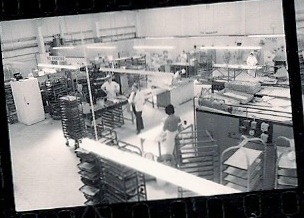
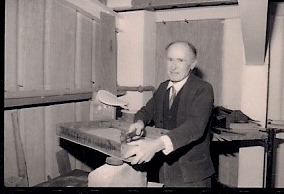
There were corners of the bake house in which debris of the different production processes assembled – the flotsam and jetsam of a partially mechanised factory. Old bread tins, old trays, bits of machines, old mixers and an assortment of broken peels and mouldy oven gloves. I liked to sit alone in these quiet corners and have cups of tea or Danish pastries pilfered from the racks in dispatch. What was possible here was to revert to being a child by playing and imagining. In these moments the anxiety of work was removed. Things could assume magical qualities in these spaces, becoming caves filled with elves or pirates. Whenever he came to stay my grandfather would like to spend the day at the bakery. He would often work in these places. Overall, I think he liked things more than people. If we found ourselves together then he would get me to hold something or pass him things. He would spend hours carefully mending trays or tidying up the tools and if I could I would spend those hours with him. I think he felt that the big factory was somehow extravagant but that this corner was okay. At the height of my father’s business success the trade magazine for bakers came to do a spread. While the photographer was walking around the factory he climbed up to the storeroom that had been built above the offices to take a photograph of the whole layout of the plant. There he found my grandfather, hammer in hand, fixing wooden cake trays.

My Dad and his dad were happiest when working together. Either doing jobs or at home making wine. This was an annual ritual in the later part of Dad’s life. A few of his friends would club together to buy grapes. These would arrive in a lorry and be put through a grape crusher which they hired in turn. The wine was of variable quality. Nunno, (my grandfather was Nunno and my grandmother, Nonna) would turn the handle on the crusher and clean the demijohns. At these moments Dad and his Dad would talk, comment and discuss the process. I cannot remember a single conversation between them that was not about how to do something. They also napped in almost exactly the same position. After lunch or dinner they would retire to the sofa and very quickly be fast asleep, head back and mouth slightly open. In later years my brother sometimes joined them. Three generations of sleeping Brivati.

Sonhood 7

Sonhood 1 Sonhood 6

The width of the big jag was ideal for my Dad. He was strikingly large. 18 stone. This was something to do with the flour, a chemical reaction or illness my mother said. I have never understood what it was. I suspect it was how and what he ate: too much and too quickly. He loved food and enjoyed eating in restaurants. After a big dinner at somewhere like the restaurant of the five star Palace Court Hotel onWestover Roadin the centre ofBournemouth, he would lean back, light a cigar and say something like: “That meal cost as much as one of my minions earns in a week”. But he would have eaten his filet in a few big mouthfuls as if it was a bacon sandwich. He was more at home with a bacon sandwich and a mug of instant coffee. Indeed this was the norm. He spent his whole day making things for people to eat but he consumed food merely for fuel. He never dieted and he never activity. Work itself entailed a considerable amount of unfocussed physical exercise. Loading an oven with nine 2lb loaves on trays, with the intense heat making him sweat and the weight making him pant, was quite a workout. He was often on his feet all day going around the bakery, constantly moving, shifting boxes, shouting orders and stirring large mixes. He was always on the way to or coming back from the bakery or a meeting with a customer. Except for Saturday evenings. This was a night on which he refused to work.

Once home we would eat our evening meal together either at the table or on trays in front of the television. Talk would revolve around the bakery, the comings and goings of staff, new lines that we might sell, things that happened that day and often end with a heated discussion on some aspect of the business. This would usually be about personnel issues. Why my Dad employed this person or that person. Then he would settle down to watch a film and usually be asleep in his armchair within a few minutes. Stubbornly refusing to go to bed until what he took to be a suitably late hour.

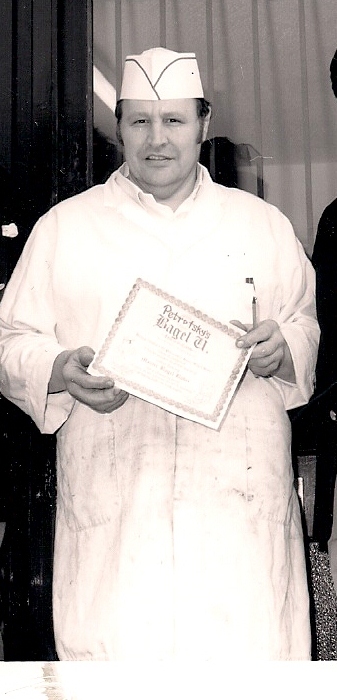
His uniform of whites – white trousers, tops and aprons – combined to make him look like a classic jolly baker. When remembered for heath and safety reasons he also wore a white hat. I usually saw him in whites and I always think of him wearing them. Whites always meant bakeries to me, whereas to most children they meant hospitals. They were like his second skin and it was disconcerting to see him out of them or in something outlandish like swimming trunks, shorts or even a tux for one of his National Association of Master Bakers Dinners.

I sat in the Jag as Dad scraped the snow off the windscreen. I was waiting for him again. The night was spent waiting for him to wake me up. I was often left somewhere to wait for him. In the office after work I would wait for him to take me home. In the evening after school I would wait and wonder if he would get home before I had to go to bed. When waiting for him it is not clear to me now if I heard him before I smelled him or the other way around. He had one of three smells and they were so striking that I can almost taste them now. There was bake house and sweat. There was clean with aftershave. There was cigar. Bake house and sweat tended to linger under the other two. Flour and yeast create a very special kind of dank aroma that made up this base smell. Sometimes he would let me watch him shave after his bath. I could not smell the sweat part anymore. Aftershave and washing had dealt with that. But I could still detect the bake house. It always lingered. I have his recipe cards for the major mixes we used in the bakery and they have this smell still.

His recipe cards allow me to conjure his smell sitting in this room. But I cannot hear his voice; at least not the sound. What I remember is the directness, the volume and the economy in forming the phrases to be used followed by the seemingly endless repetition once the right one had been found. His language was not exact but once he settled on a phrase it became a mantra. It was as though by merely repeating them often enough he could win any point – his voice was like his handwriting, always in capital letters.

 Now he was driving his Jaguar, registration number COY 99H. Cold, tiredness, and anticipation mingled within me as I huddled inside my blue Parka, with the fake fur trim, waiting for the heating system to kick in. We had barely spoken a word since he woke me. He cleared his throat into a handkerchief and picked his nose clean. My father suffered from catarrh, especially on a morning like this one. I picked my nose too and coughed. “I know I pick it, but you shouldn’t eat it”. This was the first piece of advice I remember him giving me. It was an oddly intimate moment between us. My father was interested in us but he did not have a language with which to talk to us. He was not frightened of touching or being touched. He hugged and kissed his children. He kissed my mother. We always felt loved and protected, just not spoken to, at least not at home.

He knew he had problems with us. These stemmed from the way in which his parents had been with him. I think he thought that his way of being with us was in marked contrast to his own father’s way of relating to him. But both of them were essentially egocentric in their outlook and therefore the tiny differences my Dad achieved in his approach to his children might have appeared to him as major departures but did not help us much. He took me to work with him because he wanted to spend time with me. This was the only way he knew how.  We never got close to discussing this. I am sure he would not have accepted it if we had talked about it. But he also felt bad about it and regretted that there was not a greater difference between him and my grandfather.

Writer’s Diaries Part IV: Virginia Woolf

Writer’s Diaries Part IV: Virginia Woolf.

Sonhood 6

Dad circa 1958

Sonhood 1Sonhood 5

Christmas was also the only time of the year that my Dad would join in the usual running of the home. Sometimes on a Saturday morning after work he would cook a fried breakfast. Aside from this he would never do any cooking and he certainly never baked anything at home. The joke, which was also the reality, was that we never had any cakes and the bread was always stale. But at Christmas he would sometimes cook and he would also play a board game with us.This moment in the year was so different from any other that it assumed immense significance for me. We saw my father on our terms as we played that game. It was now a world governed by rules that made us equal. In the world of the board game he was merely another competitor. He never played games with us that did not have some kind of structure or in which we had invented the rules. He never surrendered control to that extent. But for a short while he did exist on the same level as us. At least until the “big film” was due to start, at which point he would leave, infuriatingly even if this was in the middle of a game. These board games were different every year until Trivial Pursuit came out and then the tradition seemed to die and we played the same rather sad game of Trivial Pursuit for year after year without changing the cards. Or perhaps I just got older and the thrill of playing with my father dimmed.

I remember one Christmas in particular. It was the eve of Christmas Eve in 1978. I was in my bedroom of our house inNewstead   Road, Southbourne,Bournemouth, Dorest. I glanced at the red display of my digital alarm. I was very proud of that alarm. Next to my radio with the directional antennae on top (on which I listened to geeky things yesterday in Parliament, Letter fromAmerica, Just a minute and the Hitch Hiker’s Guide to the Galaxy) the alarm was my favourite gadget. The numbers gave off a red glow. You could alter the minutes by pressing down switches and rolling quickly through hours, imaging that you travelled through the time the numbers marked. Games of time travel could sometimes keep me up half the night but on this night I was really trying to fall asleep. I wasn’t properly tired so it was difficult. I pushed the curtain back and watched the snow falling. The window was steamed up, cold and wet to the touch as I cleared a space to look through. Frost was forming on the windowsill and around the edges of the glass. The space between our house and next-door still recurs frequently in my dreams. It is usually flooded and impassable. I am always inside the house looking out over the flood. The water keeps me at home and I never seem to want to escape the flood. This is the first house I remember us living in and the only house we were ever forced to leave.

I remained watching until a sound from downstairs, perhaps my mum getting ready for bed, startled me. I looked at the time; I would now only get a maximum of five hours sleep. I slid, reluctantly, under the stripy quilt and snuggled down again. For some reason on nights like these I tried to stay up late listening to my radio or reading under the covers while knowing that I had to get some rest or the shift would be a nightmare. Slowly I slipped into half sleep and half wakefulness. When in this state I would often dream of the day’s games of Dungeons and Dragons or the week’s big soccer match. I was also prone to walk in my sleep. Once my mother found me in the hallway fighting a duel. She told me to go back to bed. I replied, “I’ll just finish this one off, mum”. Another time I went into my parents room to explain some intricate point about a game, then asked if they understood and went back to bed, apparently satisfied.

On this night I did not sleep walk but continued to doze until I heard my father in the bathroom. In fact I must have slept because I had not heard him come in. He had grabbed a few hours rest and was now going back to the bakery to start another shift. I closed my eyes tightly until the door opened. “Come on Titch”. I climbed out of bed. Right then:  a splash of water on my face, then many layers over my body and last coffee diluted with cold water so I could drink it quicker. Trainers on, parker zipped up and we were off to rescue the cigar smelling Jaguar from the snow. Dad’s face was pale from exhaustion but he could not disguise the excitement he felt at the drama about to unfold. It was3am.

Divorce

We are told:

Women cannot let go

Nor men keep hold.

It is the impasse, trade-face off,

In the duels of our days.

And no one knows who can win,

When we fall apart

But as we recover, make ourselves whole

Only our children have lost

As we could all have foretold.

They will love their new families

Find many things to keep hold

But they will always glance back

And wish the story

Of their first family, to be retold.