Sonhood 13


Sonhood begins here

The jobs I preferred in the bakery were ones that I could take all the way through to the finished product rather than just be a part of. Most of the things made in the day were started and finished by different people over a longer period and with more stages in the process. For example the small fancy cakes, one of which had a flake on the top and was covered in chocolate, and the gateaux and fruit tarts, were made by a team of mainly female confectioners led by the massive and forbidding presence of Annie. When Dad lost his business, Annie sent him a card on which she wrote: “As bosses go, you went.”

Anne’s team of daytime confectioners had an odd place in the hierarchy of bake house life. In some eras they even had their own deliveryman. On a couple of occasions I came in to do the packing of these orders. Many of the cakes were designed from a huge book called The International Confectioners. The small fancies were based around a simple design: a rectangle square of sponge with a jam filling. From this base the wide range of different fancies were produced by dipping them in different things, decorating them in different ways and sprinkling the tops of the icing with finishes of different kinds: cherries, vermicelli, chocolate flakes. There were also various kinds of macaroon biscuits. There were Viennese fingers, Lemon Supremes, Jam tarts, chocolate fudge cakes, congress tarts, fruit squares, rum truffles, pineapple delights, Russian slices, Almond glace, Madeline, and Banbury.

The Madelines were actually rather a con. They were nothing like a proper Madeline but rather a Genoese sponge covered in fondant with coconut and a cherry on top. I am not sure Proust would have approved. Indeed it was odd how the names of some of these cakes had been transferred from one thing to another. A Madeline should be much closer to the Viennese finger than to a fudge cake. It is a light sponge and has nothing to do with fondant. However, in the international confectioner these Madeline had become coated in fondant. By whatever process of development these had become our fancies. They were made by women and therefore had an essentially female character for me. They were also made during the day, in a fixed working pattern and in an area of the bakery that always remained relatively clean. The women would also tease me much more than the men, not playing jokes but making remarks that made me blush. I hated working on fancies. The worst thing of all was if the night shift would arrive before I had finished, everyone would know I had been “messing about the girls” that day.

Next to the confectionary girls, and below them were the shop girls.

If he bake house was masculine, then the world of our retail shops was feminine. Mum did much of the running of the shops, hiring and firing, training up the manageress and shop girls. Except for my occasional shifts, only girls worked in the shops. Their atmosphere and cleanliness made them feel closer to home than the bake house. They were more relaxed but not as exciting. Their femininity was challenging for me because I would sometimes be teased or playfully flirted with. But the masculinity of the bake house was much harder to cope with and more exciting to be part of. Looking back now I realise that I grew up in a world of layered machismo that was more Latin American than English and that the odd weekend working in the shops was a welcome rest from this.

Unpacking the fresh goods in the shop and making a good window display could also be great fun especially on a Sunday morning if my Dad had done the baking and the stuff was looking very good. As long as the stuff was cool and the icing dry, you could pile up the morning goods to really fill the window with trays of doughnuts, Danish pastries, scones, almond rings, Chelsea buns and anything else that could be piled high. Or we would make a display of crusty bloomers and French sticks. All the goods that appeared on those Sunday mornings were a good size and had good finishes, so they looked great in the window. There was a certain quality to my father’s goods that made them stand out. The bread had a crusty finish that was the right colour. The doughnuts held their size and were well coated in sugar. The Danish were plump, had good sized pieces of fruits and a decent amount of fondant icing – indeed all the yeast goods looked properly risen, generous and not mass produced. In terms of flavour, Dad used a little more spice and essence than most English bakers, which also meant that his shops had a wonderful smell. It would be lovely to write that all this quality, attractiveness and flavour was achieved because of my Dad’s superior skill. As a boy this is obviously what I believed to be the case.

This belief was connected with the machismo of the bakery. The layers or levels of machismo were defined in hierarchies of jobs based on the level of skill and physical effort involved in each task. In this world youth was a strong protective device, most of the time, from the perpetual ridicule. It is striking that the tone of the bake house was competitive and dismissive by turns. The tone of the shops was much gentler. It was competitive in the sense of macho point scoring rather than sports. In sports the scores are written down and remembered, even memorised. In the bake house the moment was what counted, the pleasure in the moment of triumph and victory. It was a bit like driving in London, another bastion of this macho need to be on top if only for a second. But beneath these verbal games of teasing and knowing, of roles and structures, the deeper machismo was more difficult for a child to cope with.

My Dad was also my Daddy. There was a barrier to be crossed when he stopped being Dad and become the boss. Once he asked me specifically not to call him Daddy at work. Dad was fine, father was fine, even boss was fine but not Daddy. I found it very confusing. I wanted him to be the same person who kissed me goodnight. Later I came to see that he was the same person but that the worlds were different. In part this was the natural process of him becoming a mortal in my eyes. This process was also symbolically carried out in the bake house and one key moment in it concerned how Dad got the quality of finish I so enjoyed unpacking in the shops.
Sonhood 12


Sonhood begins here
The secretaries occupied the bottom of the bakery’s human social system. Not the cleaners. I am not sure why I placed the cleaners above the office staff. They were just a little bit closer to making things than those concerned with office process I suppose. I had no idea at the time of course that I was mirroring a permanent lament amongst academics. Academics, as a breed, complain as a reflex to the beginning of each working day. They complain most about administration, even if, as is often the case they have long ago given up on research and use administration as a means of avoiding contact with students. They internalised at some point early in their careers that administration was not real work. In my teens I felt this about the divide between the office workers who processed the orders, answered the phones and produced the overall production totals, and everyone else. But why not put cleaners at the bottom of the pile? They did not make anything after all. Looking back I think it was two things. First they were generally characters of some kind. Austin was tall and , to my teenage mind, mmensely stupid. My father was eighteen stone but Arthur was the largest person I had ever seen. He was unfeasibly, unsustainably round – like a huge telly tubby. His belt fascinated me because it seemed to hold his stomach in place. I imagined that when he went home and undid his belt he would immediately topple over as layers and layers of fat escaped. He sweated constantly and was so dirty that I could not imagine what contribution he made to the actual cleaning. But my father employed him for years.

Austin was kept around to be shouted at. He was tall and almost hairless. The two together were like the number 10. Austin who looked and glistened a bit like the Rev Ian Paisley, at least kept himself clean. His trouble was that he would become fixated on a particular spot in the bakery, cleaning a small area of floor over and over again until Dad noticed him. Then he would move to another patch and get stuck in there.  They came into their slapstick own when they put away their old brooms and set out to use the high tech cleaning and drying machines for the floor. One of the machines made a soapy wet mess and the other machine dried this up. Now after lunch on Saturday when no shift was starting until the following morning, the Austin and Arthur show could run unimpeded. At any other time the gap between the shifts was relatively small but particular areas of the bakery would become especially greasy. Grease was a real enemy. Many things produced it: the tins being prepared for the ovens, frying the doughnuts but also the making of almost any recipe requiring fat of some kind. Also making almost anything meant that tins had to be opened which might cause things to spill out, and the constant flow of the racks and trolley traffic would then spread the mess across much larger areas. Austin and Arthur therefore had to make a judgement. They had to make a rational choice by ranking their preferences: did they prefer to be shouted at by my father because they had not cleaned up a particularly dirty part of the last shift or because they were still cleaning when the new shift came in. Almost always they were caught between the two and my father would let rip.

Their purpose was to be shouted at. There was a part of my father that understood some elementary things about mental health. It was reflected in the way in which my parents had arguments. Tension would mount remarkably quickly and then there would be an explosion of shouting, repetitive on my father’s part and increasingly angry on my mother’s. To further needle my mother, Dad used repetition. Even when it was obvious that he had lost the argument and actually agreed with my mother he would continue to say the same things. They would occasionally resort to Italian, though as this was not my father’s first language he did not do so as naturally as my mother, except to swear.

Sonhood 11


Sonhood begins here

Working a double shift with only a short rest was fairly typical of the physical demands my father liked to make on himself at busy times of year and when there was some sort of problem. There were often problems. The small bakery business functions in a cycle of production, distribution, sale and return. This cycle is vulnerable to many different kinds of disruption.

Stock controls can breakdown leaving you without vital ingredients or deliveries from wholesalers can fail to come in so you have to drive around other local bakeries and borrow things. Things can go wrong with the dough mixes so entire batches of bread or cakes have to be made again. Even after all the stuff is made there are problems. Drivers can load badly so that a sharp emergency stop will topple the tall towers of goods. If anything has gone wrong in production then as dawn approaches the packers will be arguing over the absence of the correct stock from earlier on in the shift. Packers also made genuine mistakes by miscounting something or leaving someone short of something. A tray or two will go to the wrong place and very few customers report a surplus. However, if they are short of anything they will be on the phone complaining by mid-morning. This adds to the overall headache.

But mistakes and shortages could also be the fault of staff. All staff steal. There is a sliding scale from the occasional roll for breakfast to substantial amounts packed in the wrong orders and delivered for cash to the wrong customers. Drivers can take things to the wrong place. Mix-up orders. Steal things off the back of the lorry and then claim the order was short. Drop things. Staff can also let you down at the last minute and you have to persuade people to stay on or come in early. Or worse, you have to phone one of the casual bakers who do the odd shift, some working other jobs and others working the benefit system. These characters might turn up or they might not. At really busy times they might get a better offer or if it is the height of the summer the sun might come out and they will head to the beach instead. Sometimes just the sheer size of the order throws you and your timings go wrong; all of which contributes to your labour costs and eats into your margins.

There was an underlying logic to the lay out of the bake house that was meant to create a flow of production. The stages in making each of the many lines that we carried was pretty much the same but there was a divide between those things which could be made ahead of time and either stored for baking off or packed for a longer life and other things that had to be made the night before they would be dispatched. This created another layer to the social hierarchy of the bake house, in my mind at least. The bread bakers were dominant. This was a position based on skill. There was a separate hierarchy amongst the drivers that was based on the number of wire baskets they could carry. But there were other layers of this class system and I imagined the bread and cakes themselves to have a social system of their own.

As I child I watched this little society and I made connections between it and what I was learning in school about Angles and Saxons, about Normans and the fall of feudalism, later about the industrial and the French revolutions, about Napoleon and the world of Dumas. In my mind then and in my memory now, there were ancient castes represented in the different functions performed by different people in the bakery and these differences were reflected in the goods themselves. I also linked them to my toys and games at home. I was between a world of toys and a world of books, between reality being my bedroom games and understanding that the world outside is made entirely independently of me. It was like that moment in life when you realise that other people exist for purposes other than the role they play in serving your own needs. With siblings this moment comes remarkably. The world of my games and toys remained a better reality for longer than I feel it did with other people I know well. It was still much closer to me.

There was nobility in some our products and the processes that went into to making them. There were also barbarians. The social structures were pyramid shaped with the bread bakers at the top. Therefore what they made were knights, regimented in their bread trolleys, crusty topped and unstoppable. The whole bread and Hovis tinned were like so many industrial magnates. All this fresh bread was the aristocracy of the bakery and it was English. There were, however, other pockets of nobility. The bloomers were like dandies in their 18th century frock coats. I always thought of the cream cakes as French nobles, with long canes and big hats and big hair, characters from the Three Musketeers. They also had this status because they could not be packed too tightly, having a space of their own in each of the trays. The uncut bread too had to have its own space in a single layer but was pushed up against each other.

In between these groups came the suburban middle class. In terms of the staff these were the pastry and choux bakers who made things but did not generally do bread or yeast products. In terms of goods these were the meat filled short crust pastry items like sausage rolls, meat pies, Cornish pasties and the rest. Allied to them were the fruit tarts in silver foil cases and the pound cakes of various kinds, cherry, fruit, date and walnut and so on. These were all solid citizens of the bake house lines – the bakewell tarts, the bread puddings, the almond rings. Larger than the individual items below them but not quite as significant or individual as the fresh cream cakes or larger gateaux like the Black Forest or the Strawberry Tart, they nevertheless had to be treated with care. They were packed carefully and the people who made them all had sufficient skill to be recognised as proper bakers.

Finally there were the masses: the bread rolls of all varieties, the buns of various kinds, and at the very bottom of the social heap – the cut bread. The rolls, when cool and either packed or unpacked could be heaped into the baskets in multiple rows, sometimes a dozen at a time. The buns could also come off their metal trays in fours or sixes and be packed in large numbers. These were the jumbled-up masses, the barbarian hordes. They sustained the heaviest losses in the time from production to packing. Many were broken and many were taken for morning snacks to be eaten hurriedly between the piles of wire baskets.

Imagining the bakery like this always helped me get through a long shift. There were other ways in which the world of games at home crossed over into the world of the bakery in my mind. If I had a rack of goods to cling film, for example, I divided the rack into sections set the clock and raced to see how many I could do in different segments of time. Or I imagined that the bakery was supplying the armies fighting the siege that began the opening titles of the Flashing Blade. As each basket was filled our side’s chances of seeing off the aggressors was increased. Or I would run through a Jonh Motson commentary on the speed, efficiency and skill with which I was moving through whatever mundane task I had been allotted. The problem was that these highly enjoyable daydreams would sometimes take over and I would leave the bakery and be on the walls of the castle helping defeat the enemy. I would be in the middle of a real game of football. It was usually at this point that my father would stroll past to check on me, “Stupid Boy”, a’la Dad’s Army.

Daddy’s Book


A will like a driving spear
Hugh Gaitskell
My first book
My entire career
Daddy who was he?
She is 7
Should she care?
He had principles and practicality in equal measure.
What?
He believed in equality for all.
Why?
He was a rationalist and not an emotionalist.
The eyes glaze
The smile shrinks
She so wants to be interested
She so wants to care: but her paints are there
So in desperation: he had a will like a driving spear
What is will?
Will power, to do what you want.
Why a driving spear?
Because nothing could stop him.
Nothing?
No nothing, a spear that can cut through everything
With just what he thought?
Yes.
Like a driving spear?
Yes like a driving spear?
I like him.


Man/Woman: Who’s Got the Power?

Man/Woman: Who’s Got the Power?.

Ships

I wanted to turn back

This leaving port

All flags and fireworks

Swayed me

I wanted to press on

But only if the carnival of a beginning could be maintained

You became still and our wind dropped

Our sails drooped

We stopped.

We had no charts

Drift?

Then we remembered our way

You found it first

And then plain was our course

We looked at each other

Long edged glances

We did not forgive

We understood

In the better knowing

And when we glanced up again

Our sails were full

A new pebble

Glance – shape, colour are right. But there are hours, days, years, eternities still to go on this walk.

Should I collect all that Cley beach says is here for now? As love in lust begins, or wait until possession becomes real?

How to keep the start of the walk feeling the lightness of my step through to the very end of me.

Perfect pebble, and this, and this, the walk is young and my arm stops before it picks up because I must carry all this weight back.

I walk, touch, feel, just enough to make the walk smooth and not too much to make it burdensome.

Entire years in the walk’s expanse I pass until there is a breeze, a harbinger of autumn, the beginning has ended.

Pockets full of pebbles mean it is time to go home, weighed down towards a return to solitude and skyless city life

Experience banked and life renewed.

To move to beyond beginnings to what we will be.

Landscapes

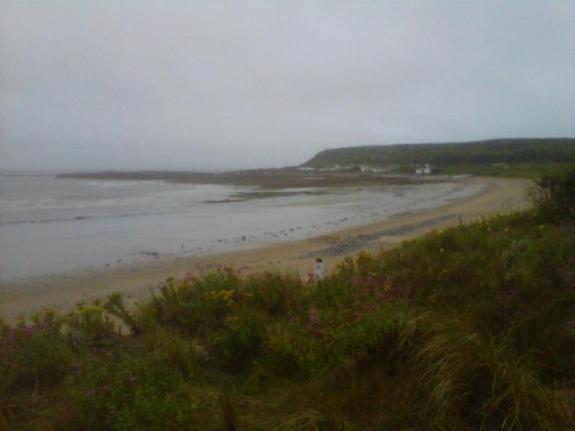
We discover, in the composed rock pools, that absences hang over us

Echoes of their running footfalls, disturb the unmoved placement of shell, water, sand worm

The curve of the bay, like my daughter’s hair at ten, unkempt but perfect.

The settled stone fortress of order and chaos where land meets sea, like my son’s Lego games at nine

The swallow catching flies, darting over the wind, like their voices from the garden below

We force ourselves, to be in this picture now

Hold hands and try to fill the picture with ourselves

So this is getting old

Learning to be alone together in the landscape of their absences

Cricket Nets


Muscles remember.

Wrists recall.

Eyes adjust.

Grips change.

Feet move.

Even murmurs from spectators

Come home to you.

Then: breath quickly shortens.

Pains appear in new places

Visions of movements fall short.

Action replays hit walls.

The final over welcomed.

Then: warm cans to rejoice.

We kissed without ambiguity, unqualified;

it was coming home for other muscles’ memories.

To play cricket. To be in love.

Knowing the meaning of winning

While expecting only a loss,

Until what is left is pleasure, pure

And because in the morning, so familiar,

the aching and the strain,

you shout against the slowing.

Once you ran all day and made love all night.

Life was the game.

But for one day again lose it all in the playing:

What else is middle age for?

Cley from Travellers rest

Across a sheet of grassland

Sky touches marshes

A green blue white line

Tinged at night by red, a healing wound

To open you need closing in

Happiness means nothing until tragedy

Unsheltering sky

Emptiness in a crowded land

Breaks down the compromises

We make with ourselves to rub along

If you sit in, not on, a landscape

If you see only sky

Or sand

Or wind

Or water

Then the places you hide

Turn into themselves

Or else

You were ready for this feeling of belonging

It had become

All at once

The time of being together

And what you had longed for

Glimpsed

Suddenly became possible

It was in your self

That the sky became open

In the landscapes of the heart

The framing of a view

The shaping of our lives

Views and lives transcend,

Triumph,

If we let them